Do I need to provide a base model for 3D rendering services?
Last Updated: Feb 16, 2026
Answer
Short answer:
No, a 3D base model is not strictly required to generate visuals in Rendair AI. You can create professional renderings using only text prompts, hand sketches, or reference images. However, providing a simple screenshot of a 3D model is often the best way to ensure architectural accuracy and specific perspective control.
Overview
In traditional rendering workflows (using engines like V-Ray or Lumion), a complete, textured 3D geometry file is mandatory. If the model does not exist, the image cannot be created.
Rendair AI operates differently. It generates visuals based on intent and pixel data, not just geometry. This means you can skip the modeling phase entirely for early concepts, or use a very rough "massing" model to establish scale without needing to model details like window frames or textures.
How it works
If you choose to use a base model, the workflow in Rendair AI is significantly lighter than traditional rendering. You do not need to export complex .obj or .fbx files for most standard generation tasks.
Position your view: Open your modeling software (Revit, SketchUp, Rhino, etc.) and navigate to the exact camera angle you want.
Take a screenshot: Capture the view as a standard image file (JPG or PNG). It can be a simple "clay" mode (untextured) or a wireframe.
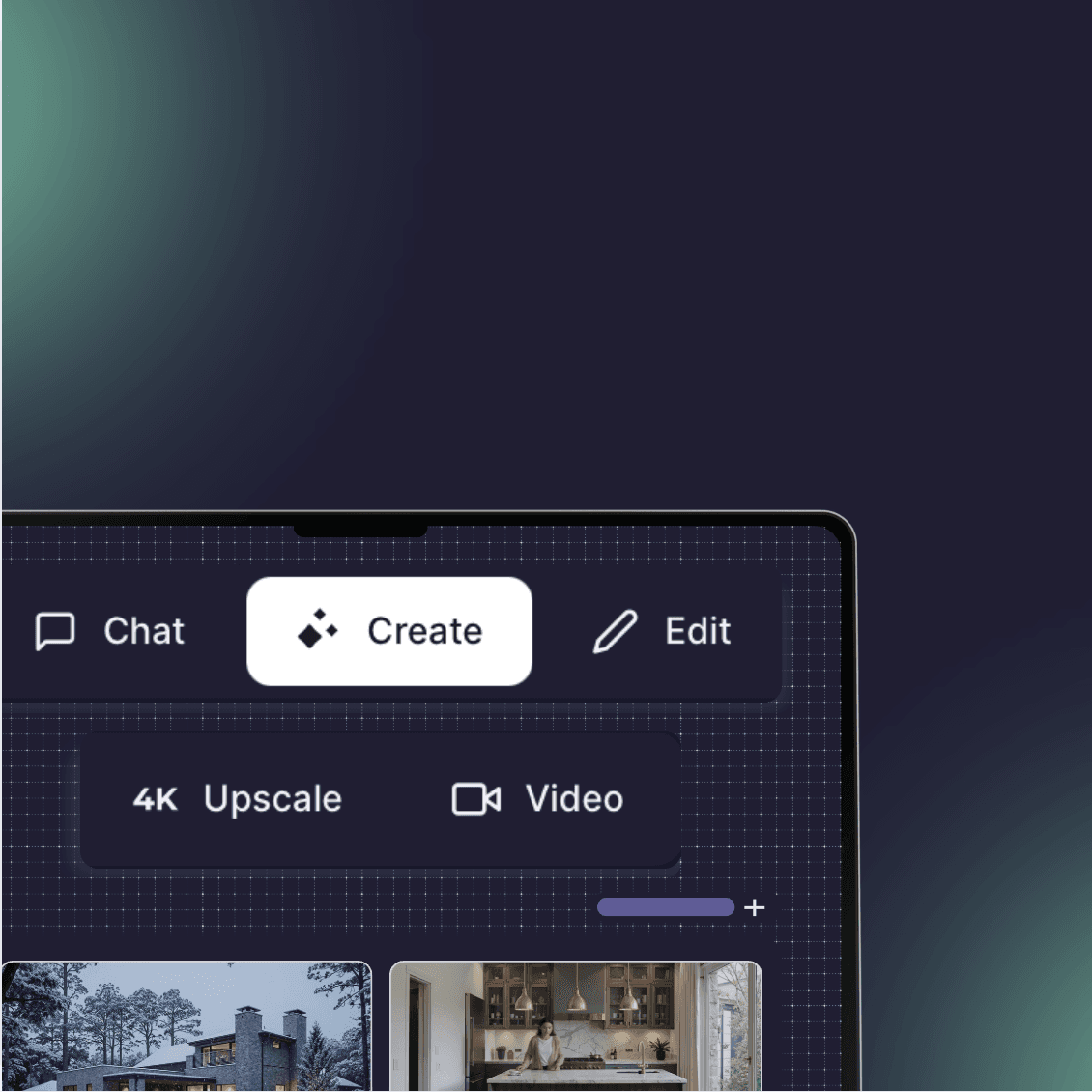
Upload to Rendair: Use the 3D Base to Render or Chat tool.
Describe the result: Use a text prompt to define materials, lighting, and atmosphere (e.g., "concrete facade, golden hour lighting, realistic glass").
Generate: The AI paints realistic textures and lighting over your screenshot, respecting the structural lines of your model.
Capabilities
Rendair AI supports multiple input methods depending on how developed your project is:
Text-to-Render: Create visuals from scratch using only words. Best for brainstorming and mood boarding.
Sketch-to-Render: Upload a loose hand drawing or iPad sketch. The AI interprets your lines as architectural forms.
3D Base-to-Render: Upload a screenshot of a 3D model. This offers the highest control over perspective and building massing.
Elevation-to-Render: Upload a flat 2D CAD elevation. The AI adds depth, shadows, and materials to create a realistic front view.
Chat: Alternatively you can access all of the same functionality inside the same Chat context.
Inputs and outputs
Inputs
Standard Image Formats: .jpg, .png, .webp, .tiff, .heic, .avif.
Documents: Single-page .pdf (converting to JPG is recommended for best results).
3D Files: Some specific "Insert" or modification tools support .obj, .fbx, .stl, and .ifc, but the primary rendering workflow relies on image-based inputs (screenshots).
Outputs
Default Resolution: ~1MP (suitable for quick iteration).
Upscaled Resolution: 2K, 4K, 6K, and up to 8K via the Upscale tool.
Aspect Ratios: Inherits the ratio of your uploaded base image (or selectable ratios like 16:9 for text-to-render).
When to use a base model
While not required, using a base model screenshot is recommended in specific scenarios:
Client Presentations: When the client needs to see their specific building design, not just a generic concept.
Site Context: When the building must fit into a specific perspective or camera angle.
Renovations: When you need to overlay new materials onto an existing structure's geometry.
When to skip the model:
Early Concept: When you want to explore 20 different facade ideas in 10 minutes.
Mood Boards: When you need to show a "vibe" (e.g., "Scandinavian interior") rather than a specific room layout.
Limitations or notes
Accuracy: AI is generative. It may occasionally interpret a shadow as a window or add details that do not exist in your model.
Complex Geometry: For extremely complex parametric shapes, a clearer, higher-contrast screenshot helps the AI understand the form better.
Absolute Precision: If your project requires 100% engineering-grade accuracy (e.g., exact brick counts or specific manufacturer furniture), Rendair offers traditional human-made 3D rendering services. These services require provided plans or models and include revision rounds for perfect control.
Do you have another question?
Search Our Knowledge Base…
Still Need Help?
Explore the platform's capabilities through a personalized demonstration or try it for free.
Contact support: support@rendair.ai
Documentation: Rendair Guides
Book A Demo: Book A Demo Session