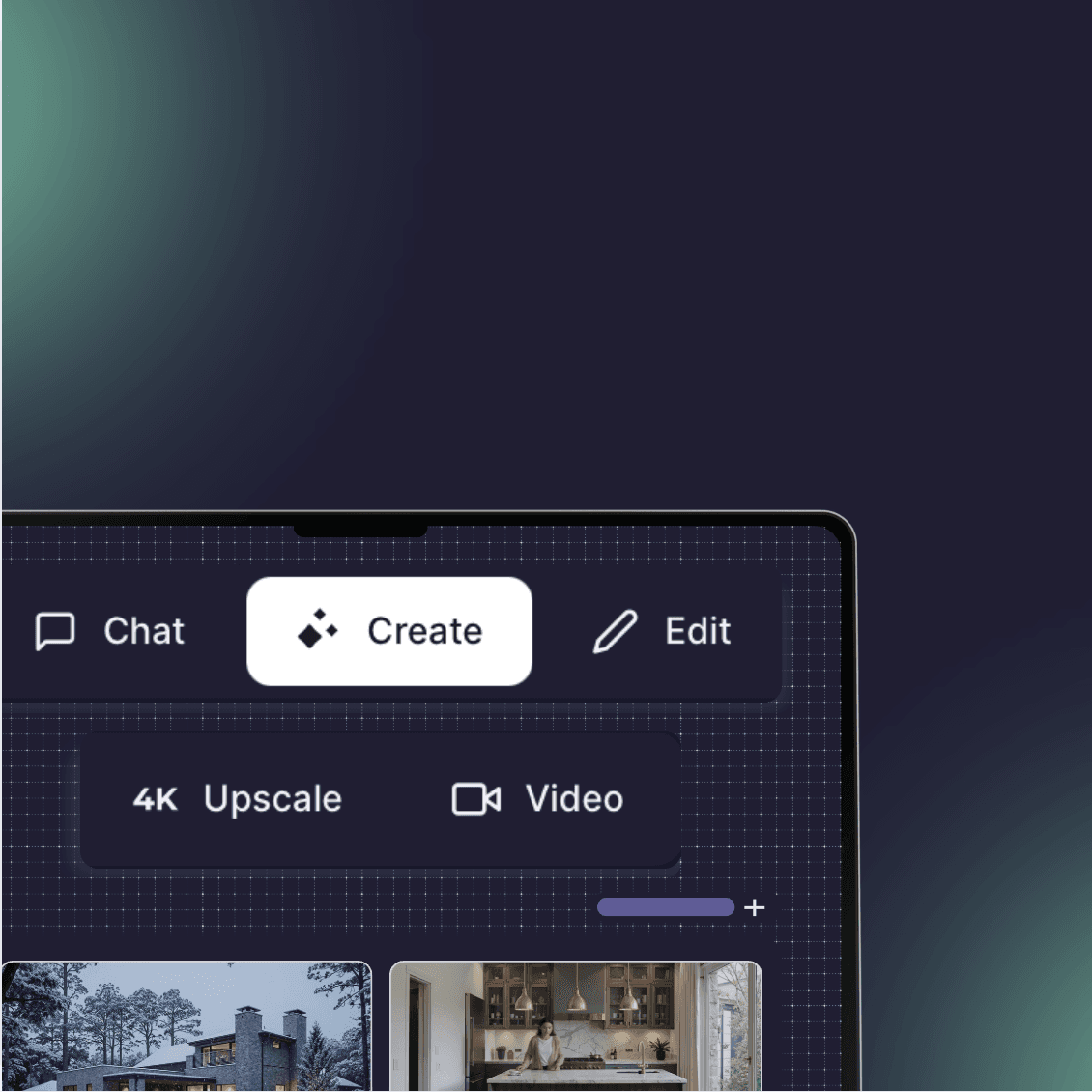
Where can I find official workflows and examples?
Last Updated: Feb 16, 2026
Answer
You can find official workflows directly within the Rendair AI platform under the Community and Tutorial tabs, on the official Rendair blog for step-by-step guides, and on the Rendair YouTube channel for video walkthroughs. For Pro and Team subscribers, personalized training sessions are available to address specific project needs.
Overview
Rendair AI is designed to be intuitive, but architectural visualization often requires specific steps to get from a rough concept to a client-ready image. "Workflows" in Rendair refer to the specific combinations of tools—like taking a raw SketchUp screenshot, rendering it, and then using the "Edit" function to refine details—that produce the best results.
Finding the right example or guide helps you move beyond simple prompting and into professional production.
Where to find resources
1/ The Community Tab (In-App)
Inside the Rendair dashboard, the Community tab serves as a live gallery of what is possible. This is the best place to see raw outputs without marketing polish.
What you see: Real user generations, including the prompt and settings used.
Why use it: To understand how specific prompts affect style and lighting.
Best for: Quick inspiration and checking realistic quality expectations.
2/ The Official Blog
The Rendair blog publishes detailed, text-based guides that break down complex tasks. These articles often cover "before and after" scenarios that are critical for understanding the value of specific tools.
Content: Step-by-step text tutorials, feature deep dives, and case studies.
Topics: "Transforming Complex Workflows," "Sketch in Context," and "Upscaling for Print."
Best for: Learning a new tool at your own pace.
3/ The Rendair YouTube Channel
For visual learners, the official YouTube channel provides real-time demonstrations. These videos show the actual speed of the platform and how to navigate the interface.
Content: Feature announcements, full workflow demos (e.g., "3D to Construction Animation"), and webinar recordings.
Best for: Seeing how different tools (Create, Edit, Animate) connect in a single session.
4/ Private Training (Pro & Team)
If you are on a Pro or Team Pro plan, you do not need to rely solely on public documentation.
Benefit: You can book private training or support sessions.
Process: Schedule a call to share your screen, show your specific input files, and get advice on the best workflow for your project.
Core workflows to explore
When browsing these resources, look for these foundational workflows that cover 90% of architectural needs:
Text-to-Render: Generating concepts from scratch using only descriptions.
Sketch-to-Render: Uploading a hand drawing or iPad sketch to generate realistic massing.
3D Base-to-Render: The most common professional workflow. Uploading a screenshot of a 3D model (SketchUp, Revit, Rhino) to apply materials and lighting while keeping geometry accurate.
Image-to-Video: Creating short animations or construction time-lapses from a single still image.
Editing & Refinement: Using the "Inpainting" or "Brush" tools to fix small errors (like removing a car or changing a material) without re-rendering the whole image.
When to use this
Onboarding: When you first sign up and need to understand the interface.
Stuck on a detail: When a specific material or lighting condition isn't looking right.
Evaluating the tool: When deciding if Rendair fits your firm’s specific design process before upgrading.
Limitations or notes
Language Support: While the interface supports multiple languages (English, Spanish, Italian, Portuguese, Hungarian, French), most video tutorials and deep-dive blog posts are primarily in English.
AI Variability: Tutorials show ideal outcomes. Your results may vary based on your specific input image quality.
Human Services: If you cannot achieve a specific result through these workflows, Rendair offers traditional human-made 3D rendering services for projects requiring exact specifications.
Do you have another question?
Search Our Knowledge Base…
Still Need Help?
Explore the platform's capabilities through a personalized demonstration or try it for free.
Contact support: support@rendair.ai
Documentation: Rendair Guides
Book A Demo: Book A Demo Session